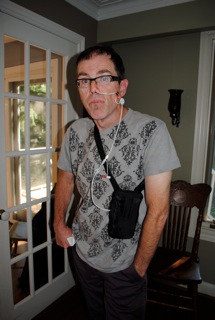
Earlier this year, I had the opportunity to participate in an on-line forum(dubbed "Google Hangout") where I posed a question to Michael J. Fox and he, in turn answered (see Hangin' Out with Michael J Fox, April 28 2013). While both the question and his answer were more complex (or perhaps convoluted), in essence, I was challenging our societal response to illness. In this case, specifically to Parkinson's and the Michael J. Fox Foundation but I do think it can be extrapolated to other disease areas.
When I was first diagnosed with PD some 13 years ago, I was thrilled to see the almost simultaneously-incorporated Fox Foundation burst onto the fundraising scene with a fervent and determined proclomation to find a cure for PD within 10 years. They forged an organizational structure that would fast-track research efforts that showed promise, they built a succcessful team of fundraisers and a solid core group of philanthropic supporters. Research was, and continues to be, carried out in a broad spectrum and at a prolific rate.
Good stuff. No question. Yet, what I do find disconcerting is the 'drift' away from the original goals and the raison d'etre of the Foundation - to find a cure. There is more talk now of early diagnosis in order to improve treatment of PD - on drug therapies to alleviate the symptoms of PD - on coping strategies for living with PD. Again, all worthwhile pursuits but no longer the consequential cure.
I don't want to sound Pollyanna. I don't believe it is an easy task. I recognize that the Foundation has accomplished a great deal. I have donated to the Foundation and even run fundraisers on their behalf. Yet, I worry that the initial goals and challenges that were set out have been lost or corrupted along the way. Does the draw of the pharmaceutical industry dollar pervert the purpose? Does the Foundation become an institutionalized entity in the PD research community rather than a vehicle set up to bring about it's own demise through uncovering that cure? And what if there is no cure?
I don't pretend to have the answers but, if anyone out there is taking a survey, put me down as one who still "wants a cure".
Thursday, June 27, 2013
Thursday, June 13, 2013
I'm a man, yes I am
In honour of Father's Day, I've decided to ruminate on what it means to be man with PD. How does Parkinson's affect my "maleness"...my "manliness"...my "manhood"?
Hmm...on second thought, maybe I won't.
Sunday, June 2, 2013
R.I.P.
One of the things I miss most from my pre-Parkinson days is a good night's sleep. I'm not talking about that alcohol-fuelled sleep brought on by a night of youthful revelry nor the spent exhaustion that followed an overly busy day of play as a child. Nor am I referring to the sleep that came to a weary body after a taxing day at the office followed by a night out for dinner and a show. What I am referring to is a "normal" 7 hours of restful sleep.
While it's been 13 years since I was officially diagnosed with Parkinson's, PD came to me some time beforehand. Years of a twitching baby finger, disturbances in sleep patterns, soreness in my extremities, and a fading sense of smell. All calling cards of a sort. It's hard to pinpoint exactly how and when PD came to rob me of my sleep but there's no use losing any sleep over it! I'm in bed with PD now and that won't change.
Through the years, I have experienced relative highs and lows. During my lowest period, I went several years getting an average of 3 hours sleep a night (3 hours in total - not 3 hours uninterrupted). I have tried numerous pharmacological and naturopathic resolutions with varying degrees of success. At present, I am the best I've been in years. I take a low dose of Zopiclone (a sleeping pill) which pretty much ensures I will get 4-5 hrs of sleep that is mostly uninterrupted. I say mostly because, while I can pretty much count on some kind of interruption during the night (if not for the very vivid dreams I have, it'll be the dog barking at something in the dark, someone using the bathroom or a car passing on the street). Yet these interruptions are relatively short and I tend to fall back to sleep within 10-15 minutes.
Yet, as satisfied as I may sound with the current state of affairs in zzz-land, I know that not all is well that ends well. I find myself easy to tire and less patient then I ought to be. I am sometimes more testy or on edge than is warranted. And most often, it is those closest to me - myself and my family - that bear the brunt. A resolution? Think I'll have to sleep on that...
Sunday, May 26, 2013
Pump It Up
![]() |
| how I get "pumped" every day |
I an earlier post, I wrote about my current treatment but several people have mentioned they missed it because it was "buried" in a longer post. For those who missed it, I've re-posted it this week.For those who have already read it, take the week off :). Or, if you are a real blog junkie, permit me to suggest where you might get your weekly fix - visit http://lilblume.blogspot.ca/. Lil Blume, a friend of mine from my old radio days, does a great job with this - inspirational and thought provoking.
I was diagnosed with Parkinson's Disease in September 2000 at the age of 43. I was advised by my original neurologist that I would be in a wheelchair in 5-10 years. While initially devastated by this news, as time went by, I became increasingly combative with this news. Each anniversary found me proud of my continued mobility and, as I approach the 13th anniversary, that wheelchair remains a part of some distant future.
Still, in the past few years, PD has seeped into, and solidified a presence, in every aspect of every day life. With the exception of 4 hours at night when I am asleep, PD brings with it varying degrees of stiffness, slowness of movement, muscle pain and weakness, reduced dexterity, tremors, cramping, dystonia (curling of toes), cognitive dysfunction and weariness. My cocktail of meds have no doubt helped, though their effectiveness wains over time and doses require regular adjustment. Fortunately, I have had good care provided from a neurological team at Toronto Western, and, in September 2011, I was given the opportunity to participate in a clinical trial for a new drug-delivery system for PD wherein my main PD meds are delivered via slow release by a pump i have strapped to my body. This began with a week of nasal injection of the drug before surgically implanting a tube that henceforth is used for on-going infusion. I am also able to periodically adjust the dosage throughout the day when I require higher levels.
While I was pleased with many of the benefits I received from this new treatment, problems at the site where the tube entered my body became too much to bear and in July 2012 I had the tube removed and temporarily resumed my regular course of oral medications. In January 2013, the tube was again implanted and I returned to the clinical trial. To date, things have been going very well, thanks in part to early intervention and constant support from my neurological team and community in-home nursing provided through CCAC.
In addition, I am fortunate to have a health support system that extends well beyond this clinical trial. From my family doctor, local pharmacist, physiotherapist, massage therapist, and of course my family and friends. It's hard to imagine going down this road without them.
![]() |
| the first few days of the clinical trial, 2011 |
![]() |
| what I'm wearing today, tomorrow and every day thereafter the brown vest that holds my pump in place! |
Wednesday, May 15, 2013
So what becomes of you, Mr. K?
It’s now been five years since I went to work one October day and realized I was no longer the teacher I wanted to be. That wasn't the only thing to have changed with advancing Parkinson's.
I was no longer the father I wanted to be.
I was no longer the lover, the brother, the son, the friend I wanted to be.
I was no longer the person I wanted to be.
Yet foremost in my mind that day were the kids I was to face – still new to me as this was a new year at yet another new school for me. My third change of schools since going on part-time disability with Parkinson’s Disease. I was starting to show increased signs of PD and felt more challenged than ever before. How do these kids perceive me when I'm in this condition? Am I seen as a teacher with little patience? An irritable or frustrated teacher? A teacher with little emotive responses? Was I "lost" or scattered as I made my way from Grade 2 music to Sr.K playtime to Grade 3 Social Studies to Grade 1 gym to Grade 2 Science? How was I helping them? How was I demonstrating my professionalism, my skills as a teacher, my love of teaching and my joy in working with these young ones?
As I started to pack up my trolley with the mornings materials for each of the classes, I decided I could not. I could not continue. I could no longer be that teacher I had been. I was doing no one any favours. It was time to recognize that this wasn’t helping anyone. I proceeded to the Principal’s office and informed him that regrettably, I was done. It was not fair to the children or my colleagues for me to continue. I was met by complete understanding and within an hour, I was packed up and gone from the school (though my moniker “ Robert Kendrick 1.0 FTE” likely still surfaces on papers at the school to this day to the puzzlement of many!).
This was not an impulsive, spur of the moment decision as I had been preparing for the eventuality that I hoped would not come. Yet it did come and on that October day, I made a life-altering decision. I don't know that there was any other one I could have made.
But I do know I was no longer the teacher I wanted to be. No longer the teacher these kids needed me to be.
Wednesday, May 8, 2013
Hit the Road, Jack
Just got back from an extended weekend in Atlanta, Georgia - a tiring but rewarding trip to be sure. The mirror shot above gives some indication of how I'm feeling after a whirlwind four days out of the country. Still, I appreciate the break. One thing I'm proud of over these past 10+ years is introducing my kids to the love of traveling. I know in their lives, they will have opportunities to see and do more than I ever will. In the past few years, I have felt an increasing urgency to spend time with them, as well as with family and friends, in places near and far from home. I want to be able to walk the streets of cities and lands while I am still mobile and, though traveling has been more complicated by PD, I have been undeterred to date. I hope this continues.
Now, I'm conscious that this isn't a travelogue but a blog. Permit me, however, to share a few pictures of some of these trips not only to highlight where we've been but let you see how much they've grown!. More to follow as we have Europe on the docket this year!
California, 2008
|
Seattle, 2008
|
Nova Scotia, 2009
|
Chicago, 2010
|
Italy, 2010
|
NYC, 2011
|
NYC, 2012
|
Sunday, April 28, 2013
Hangin' Out with Michael J Fox
One advantage of having more time is it gives me a chance to do things like this - i "hung out" on-line with Michael J Fox a week or so ago. Here's a link to the conversation (and they even posed a question from me which I had submitted prior to the program - comes up at around 10:45 of the video). Wish I had the opportunity for a retort though!
I remember when I was first diagnosed with PD (basically around the same time he went public with his), I wrote to Michael J Fox to tell him that, despite what I thought of his acting career (I never cared much for any of his shows/characters), I appreciated what he was trying to do for PD. While he clearly has more resources as a movie/tv personality, it is still admirable to see the level of activity he takes on given his condition. When I have bad days, the most activism you might be able to coax out of me is hitting the"Like" button on Facebook!
Subscribe to:
Posts (Atom)